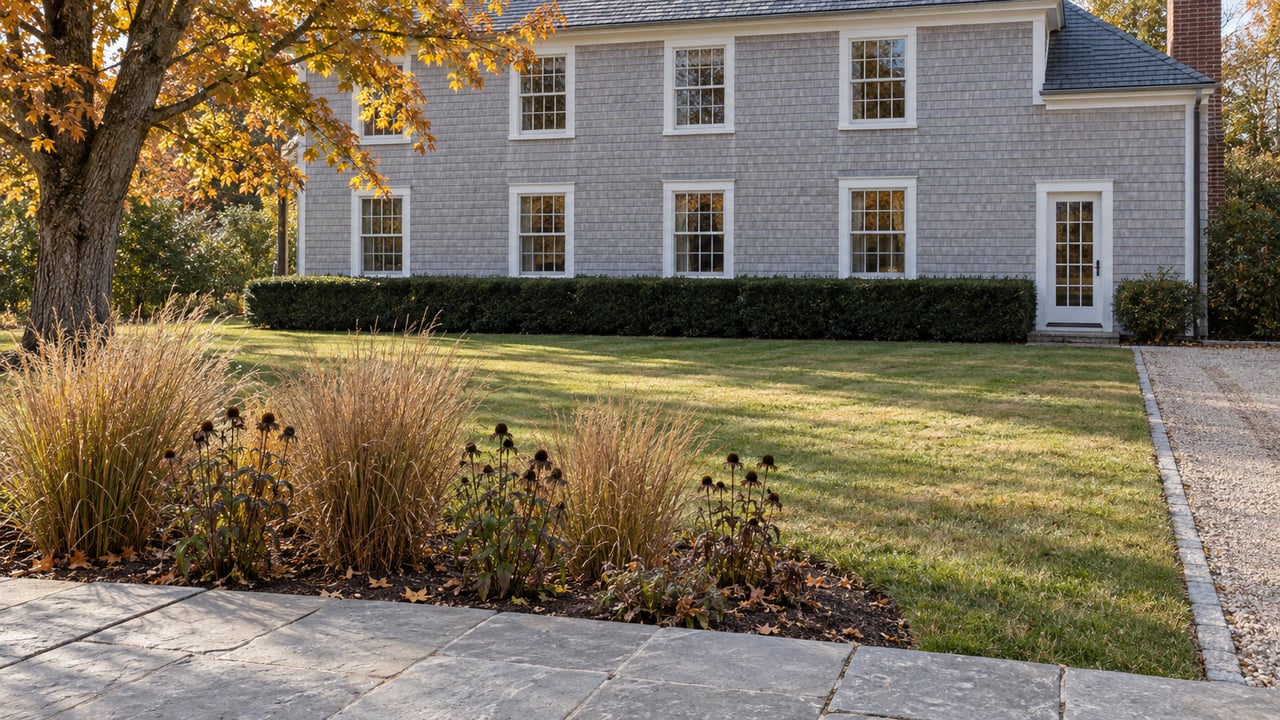
"Allowing them to have multiple lives." That is how Gina Wouters, president and CEO of Planting Fields Foundation, described the new garden's plants to Newsday in January. She meant the lives that come after flowering: the stalks, the seedheads and the slow fade to tan. The one-acre Oudolf Garden opens to the public on Saturday, October 17, a week from today. So most neighbors in the Brookvilles will first walk through it heading into the months when those second lives take over.
Most gardens get cleaned up for this time of year. This one was designed to be seen through it. Planting Fields Foundation calls it the most significant addition to the site since the Olmsted Brothers finished their work in the 1930s. It is also Piet Oudolf's first public garden on Long Island, and his first public garden in New York in more than a decade, after the High Line and the Battery.
A Garden Planted in June, Opened in October
Visitors on opening weekend will find a young garden. Planting began in June, and I LOVE NY reported on July 21 that nearly 90 percent of it was in the ground. By late July, Newsday counted more than 20,000 plants set in by staff, consultants and volunteers, with about 200 people involved in the work. The Foundation gives the full design as more than 24,000 plants, while the state's tourism announcement says over 25,000 plants and grasses drawn from more than 100 species.
The species named so far lean toward plants that hold their shape after they bloom:
- prairie dropseed, Sporobolus heterolepis
- threadleaf bluestar, Amsonia hubrichtii
- pale purple coneflower 'Hula Dancer', Echinacea pallida
- purple lovegrass, Eragrostis spectabilis
- yarrow 'Moonshine'
- calamint, Calamintha nepeta ssp. nepeta
- 'Summer Beauty' ornamental onion, Allium lusitanicum
Several of these were listed as summer highlights, so nobody should promise blooms on October 17. What a four-month-old planting does offer is a first look at the bones. Oudolf picked 15 trees and shrubs for a bed at the garden's west end, including a three-flowered maple, a 'Dura Heat' river birch and two dogwoods. His team found them at nurseries in New York and New Jersey. The Foundation says those sponsorships cover the first three years of care, its estimate of how long the roots need to take hold. The garden you see this fall is the earliest version of something meant to fill in over years.
Why the Stalks Stay Up
Wouters explained the approach directly. "Instead of cutting seed heads in the winter, the garden's curators will let visitors see the plants as they transform during the course of the year," Newsday wrote, quoting her: "His whole approach to gardening is thinking about the beauty of a garden and the value of a garden in four seasons, not just the one season when it's blooming."
Oudolf's other public gardens show how this works in practice. The Lurie Garden in Chicago's Millennium Park leaves its perennials standing through fall and winter. That gives brown, gold and tan winter color, seed for wildlife, cover for insects and nesting material. Lurie also contrasts this with the usual fall routine of cutting back browning stems so the beds look tidy and bare. On the High Line, plants are not cut back in fall either, which keeps the winter stalks and seedheads of Oudolf's four-season design in place.
The Lurie connection matters here for a specific reason. Peter Slothower, who is turning Oudolf's plans into the garden for Planting Fields Foundation, used to work at Lurie Garden. "Part of his genius is that he looks at this plan and he can envision what all of these plants are going to look like at any point in the season and through the years as they develop," Slothower told Newsday.
An Arbor From 1906 at the Center
Inside all that new planting, the oldest feature in the garden is more than a century old. James Greenleaf designed the Rose Arbor for the Byrne family around 1906. The Coes kept it when they bought Planting Fields in 1913, and their photographs show Mai Coe and a family member among its roses in 1921. Oudolf placed the arbor at the center of his acre. The Foundation is restoring it with 31 new custom-designed arbors and extra plantings for seasonal interest.
Oudolf also reshaped the ground around it. Wouters told Newsday that he visited last spring and made "a flurry of changes" to the topography. The result is a deliberate slope that hides one side of the garden from the other. The plans themselves sit on a 10-by-10-foot grid, with colored shapes and lettered abbreviations marking each plant. The paths, in Slothower's words, "reward further exploration." In winter, when the grasses thin out, the berms and the arbor frames become the garden's outline. That structure is drawn into Oudolf's plans from the start.
Three Visits, Three Gardens
The other Oudolf gardens suggest a calendar. Planting Fields has not published its own cutback date, so treat the timing below as what Lurie and the High Line do:
- Late October into November. At Lurie, this is when stems begin to brown and seedheads stay in place, though how far along this young planting will be depends on the weather and how it settles in. Weekend parking is $8 per car through mid-November.
- January and February. The stalks stay up through winter at both Lurie and the High Line, and Wouters has said Planting Fields' curators will not cut the seedheads in winter.
- After the cutback. Lurie cuts back in late winter or early spring, before the first bulbs push up leaves. It works early in the morning while the ground is frozen and generally leaves the cut material in the garden. The High Line's Spring Cutback happens in March. Whatever comes up after that point will be the garden's first full season of growth.
The garden is open on the park's regular schedule. Planting Fields Foundation lists hours of 9 a.m. to 5 p.m. daily except December 25. New York State Parks lists 9 a.m. to 4:30 p.m. The two also disagree on when the weekend and holiday vehicle fee ends: the Foundation says November 16 and State Parks says November 15. Both charge on opening weekend. Neither the Foundation nor State Parks lists a separate ticket for the Oudolf Garden.
What Else Opens Around It This Fall
The garden is the main draw, but the rest of the fall calendar runs alongside it:
- Fiona Tan, Fragment of the Foundations for a Babel Tower. The 2026 Catalyst installation opens the same day, October 17, on the East Lawn, and stays on view through fall 2027.
- Gold Coast Garden Tour: Fall Season. Fridays and Saturdays through October 31, 11 a.m. to noon, with a stop outside the new garden. Tickets are $18 general, $17 seniors and $5 ages 6 to 17.
- Secret Spots Golf Cart Tour. Wednesdays, Fridays and Saturdays through October 30, $60 per rider.
- Fall 5K Run/Walk. Saturday, October 24, starting at 7:30 a.m. Registration is $45 through October 23 and $50 on race day.
- Trick or Treat Tours in the Main House. October 23 to 25 and October 30 to 31, 1 to 4 p.m.
- Main House tours. Friday through Sunday through November 15. Self-guided tours start at $15 and guided tours at $18.
- First Fridays: The Wonderful World of Everett Shinn. November 6, 10 to 11 a.m., $25. The tour includes Mai Coe's Dressing Room panels and a look inside the recently restored Tea House.
- The greenhouses. The Main and Camellia Greenhouses are free, Wednesday through Monday, 10 a.m. to 4 p.m. State Parks calls the Camellia Greenhouse the largest camellia collection in the Northeast.
Money for what comes next is already set. In August, New York State Parks announced a $1 million Environmental Protection Fund investment from the FY27 state budget. It will go toward restoring and enhancing the park's historic gardens. The park itself draws more than 250,000 visitors a year. Anyone who wants a name attached to the new garden can still sponsor individual plants for $25, $50 or $100.
Many Gold Coast homes have old gardens of their own, sometimes with a rose arbor or a hedge from the same era as Greenleaf's, and caring for them takes patience across seasons. If you are weighing what your own grounds mean for a future sale or purchase, Cottie Maxwell would be glad to walk them with you. Schedule a private consultation with Cottie.