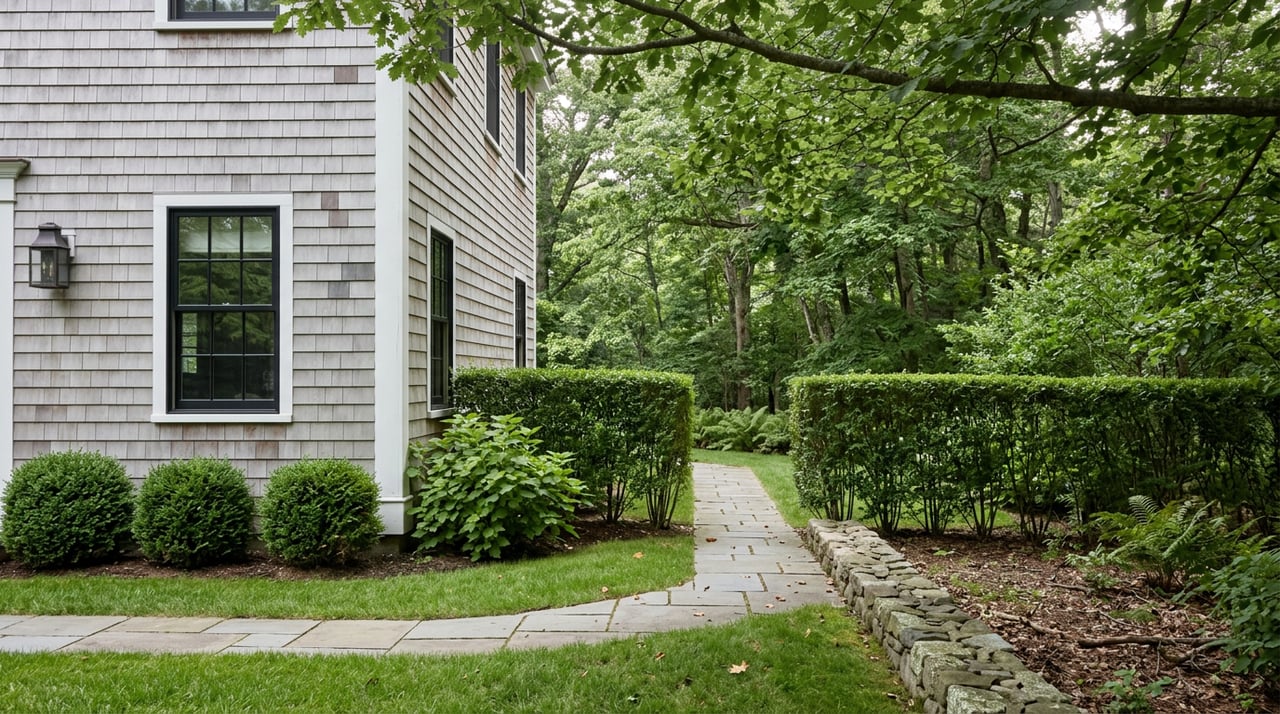
Cove Road does not announce where one protected parcel ends and another begins. There is no fence between the Theodore Roosevelt Sanctuary and Youngs Memorial Cemetery next door, no sign marking where Emlen Roosevelt's gift to the Audubon Society picks up and the burial ground his cousin's family chartered a generation earlier leaves off. You cross from one to the other on a gravel path lined with the same oak and chestnut canopy, and if you did not already know the history, you would assume it was all one property, planned that way from the start.
It was not planned. It happened three separate times, by three unrelated families, across nearly a century, and the fact that it kept happening is the reason a walk through this corner of the village still feels like it did before anyone thought to call it a corner of the village.
Three Names, One Habit
Most guides to this stretch of the North Shore treat Sagamore Hill, the Audubon sanctuary, and Youngs Memorial Cemetery as separate stops on a Theodore Roosevelt itinerary. They are that. But narrow the frame to Oyster Bay Cove itself and a different pattern shows up: individual landowners, at different moments, choosing to remove land from development rather than sell it into the market. The habit shows up again a mile or so away at the Cordelia Hepburn Cushman Preserve, a 15-acre stand of mature oak and chestnut forest on Route 25A that has nothing to do with the Roosevelt family and everything to do with the same instinct.
Here is what that instinct actually produced, in the numbers each steward left behind:
| Site | Size | Steward Today | Set Aside |
|---|---|---|---|
| Theodore Roosevelt Sanctuary and Audubon Center | 14 acres | Audubon New York | 1923 |
| Youngs Memorial Cemetery | Small burial ground | Independent nonprofit corporation | Chartered 1901 |
| Cordelia Hepburn Cushman Preserve | 15 acres | North Shore Land Alliance | Donated 1973 |
None of these three decisions depended on the others. None of them required a village ordinance or a zoning board. Each one was a private landowner deciding that a specific piece of ground would stay wooded, and each decision has now outlasted the person who made it by more than fifty years, and in the cemetery's case by well over a century.
The Decision That Made the Sanctuary
When Theodore Roosevelt died at Sagamore Hill in January 1919, his family carried him a mile down the road to Youngs Memorial Cemetery, a small burying ground the Youngs family had kept on their own land since the 1660s and formally chartered as a nonprofit corporation in 1901. That much is straightforward. What happened next is the part that actually shaped the neighborhood.
Emlen Roosevelt, TR's cousin and next-door neighbor, watched the land around the cemetery and worried about what might eventually surround his cousin's grave. So he bought the adjoining acreage himself, specifically, according to the National Park Service's own account of the site, to protect the cemetery from what the agency's history describes as inappropriate development. He then gave part of that land back to the cemetery and donated the rest to the National Audubon Society in 1923, creating what would become the Theodore Roosevelt Sanctuary and Audubon Center, the first songbird sanctuary the organization ever established. Roosevelt had told Emlen that this stretch of forested cove held the greatest variety of birds anywhere around Oyster Bay, and Emlen built the gift around that specific memory rather than around any general conservation principle.
The sanctuary has grown slightly since then. Audubon's own visitor information now lists 14 acres, a native plant demonstration garden, several small ponds, and a mile of trails, with a memorial fountain by sculptor Bessie Potter Vonnoh dedicated on the grounds in 1927. But the founding move was a real estate transaction driven by one family trying to keep one specific view from changing. The rest of the North Shore's development history moved forward around that decision. This 14-acre pocket did not.
The Cushman Chain of Custody
The Cushman Preserve tells a different version of the same story, this time with no Roosevelt connection at all. Cordelia Cushman, who served on several social welfare boards in New York City during her lifetime, died in 1960. Her husband's family held onto a 15-acre wooded parcel off Route 25A, and in 1973 Roderick Cushman donated it to The Nature Conservancy in her memory, according to a Stony Brook University history of Long Island women who shaped the region's preserved land. The Conservancy managed it for nearly forty years before transferring stewardship to the North Shore Land Alliance in 2012, the organization that still maintains the preserve's mile of gently rolling trail through oak and chestnut forest today.
What makes this handoff worth noting is what did not happen at any point along the way. Nobody subdivided the 15 acres. Nobody sold it to settle an estate. Two different conservation organizations, forty years and one transfer of stewardship apart, kept the same 15-acre footprint intact because the original gift came with the expectation that it would stay wooded, not because any regulation required it.
What You Actually Find Walking There
None of this history is visible when you are standing on the trail, which is part of the point. What you find on the ground is simpler:
- Youngs Memorial Cemetery, at 134 Cove Rd, is open 9 a.m. to 5 p.m. in summer and 9 a.m. to dusk the rest of the year, with a small free gravel lot at the entrance. A paved path climbs a hillside to the Roosevelt grave enclosure, the last stretch marked by 26 steps, one for each ordinal number of his presidency.
- The Theodore Roosevelt Sanctuary and Audubon Center, sharing the Cove Road address, keeps office hours of 9 a.m. to 4 p.m. on weekdays and noon to 4 p.m. on weekends. Its mile of trail loops past the pond and demonstration gardens before reaching the gravesite at the property's edge.
- The Cordelia Hepburn Cushman Preserve, reached from Route 25A, has parking for only two or three cars and is open dawn to dusk. The trail is short, roughly a mile, and moves along gentle hills through forest understory that hikers note includes more than a dozen protected plant species.
None of these three sites require a car to feel far from the village center, and none of them charge admission. What they share is scale. Each one is small enough that a resident can walk the whole thing on a weekday morning before the Oysterfest crowds fill Audrey Avenue a few miles up the road in October, and small enough that the quiet never quite breaks.
Why the Habit Still Matters
It would be easy to read all of this as antique trivia, three old land gifts with a shared zip code. But the pattern is still active. The North Shore Land Alliance that now manages the Cushman Preserve continues to accept and steward land across the North Shore, which means the same private-decision mechanism that protected these 15 acres in 1973 is still the mechanism protecting new parcels today. Nothing about Oyster Bay Cove's zoning code required Emlen Roosevelt to buy the land around his cousin's grave, and nothing required Roderick Cushman to give his family's forest away rather than sell it. The village's character in this corner exists because individual owners, more than once, chose the same answer to the same question, and their choices have simply not been reversed.
That is a different kind of stability than a market report can capture. A walk from the cemetery gate to the sanctuary pond to the Cushman trailhead is not a scenic loop assembled for visitors. It is a record of three separate people deciding, at three separate moments, that the woods around them were worth more standing than sold.
If you already live in Oyster Bay Cove, none of this changes your Saturday morning. You still park at the small lot on Cove Road, still climb the 26 steps if that is where you are headed, still hear the same birds Roosevelt asked his cousin to protect. But it is worth knowing, the next time you cross an unmarked boundary between one preserved acre and the next, that the boundary exists because someone with no obligation to draw it did anyway.
For residents thinking further ahead about property in this part of the North Shore, whether that means understanding how conservation land borders affect a specific lot or simply wanting a second opinion from someone who knows this village's history in detail, Cottie Maxwell welcomes the conversation. Schedule a private consultation with Cottie whenever the time is right.